Build vs. Buy: Should You Build Your Own AI Onboarding Tool or Buy Purpose-Built Software?
For most SMB and mid-market customer success teams, building your own AI onboarding tool will cost you more and risk more than buying purpose-built software. Not because building is impossible. Because the costs that sink it are the ones that never show up in the original plan. They show up later, in your payroll, your customer relationships, and a metered bill that grows every time you win. The build vs. buy question is real, and it deserves a straight answer. We have done a lot of the building ourselves, which means we've had to decide what's worth building in house and what isn't. This is that reasoning, applied to onboarding.


Build vs. Buy: Should You Build Your Own AI Onboarding Tool or Buy Purpose-Built Software?
An honest breakdown of the real tradeoffs, written by someone with skin in the game.
For most SMB and mid-market customer success teams, building your own AI onboarding tool will cost you more and risk more than buying purpose-built software. Not because building is impossible. Because the costs that sink it are the ones that never show up in the original plan. They show up later, in your payroll, your customer relationships, and a metered bill that grows every time you win.
The build vs. buy question is real, and it deserves a straight answer. We have done a lot of the building ourselves, which means we've had to decide what's worth building in house and what isn't. This is that reasoning, applied to onboarding.
The short version
If you're skimming, here's the whole argument:
The API key is the cheapest part. The real cost of a DIY AI build is a stack of recurring, hard-to-forecast bills plus a chunk of someone's salary, and that cost grows as you add customers.
It usually lives in one person's head. When the person who built it leaves, you don't have a system. You have an orphaned dependency.
It fails silently. LLM workflows drift. The outputs stay plausible while quietly becoming wrong, and you find out when a customer escalates or churns.
You're experimenting on your highest-stakes customers. Onboarding is the worst possible place to run a "let's see how this holds up" experiment.
The honest exception is narrow. If your process is genuinely unusual and you have engineers to own it responsibly, building can be right. Most teams don't meet that bar.
For most SMB and mid-market CS teams, the answer is buy. The rest of this post is why.
What "building in house" actually means in 2026
Start with what's really being proposed, because it changes the entire risk picture.
When a team says they'll build their own AI onboarding workflow, they almost never mean standing up an engineering team for six months. They mean someone, usually a CS ops person or a technically capable CSM, is going to wire something together with Claude or ChatGPT, an automation tool, a few connected apps, and some prompts that work well enough in a demo.
That's a legitimately impressive thing that one person can now do. It's also a very different object than a properly engineered internal tool. The right question isn't "can we build this." It's: is the person building this an engineer with version control, documentation, and a QA process? Or is it a smart non-engineer doing their best with tools they picked up last quarter?
That's not a knock on non-engineers. It's an honest accounting of what you're actually deploying in front of paying customers when you "keep it in house."
The operating costs nobody budgets for
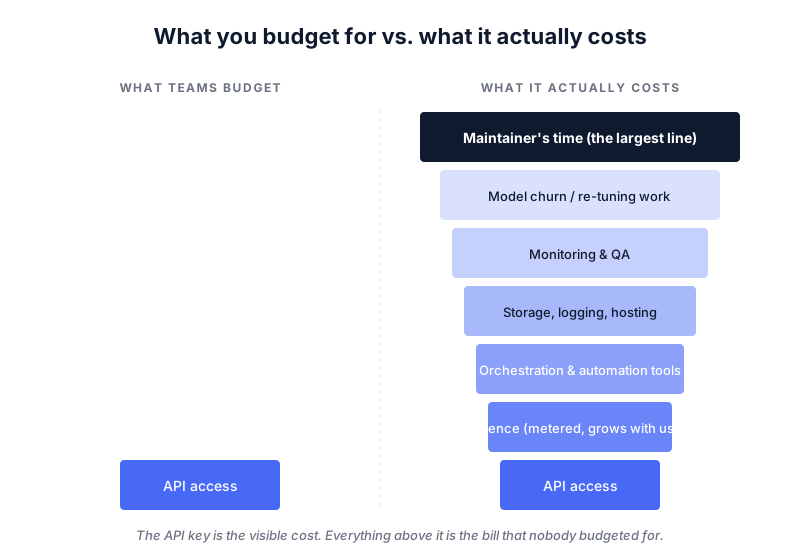 This is the part teams consistently miss, so it goes first.
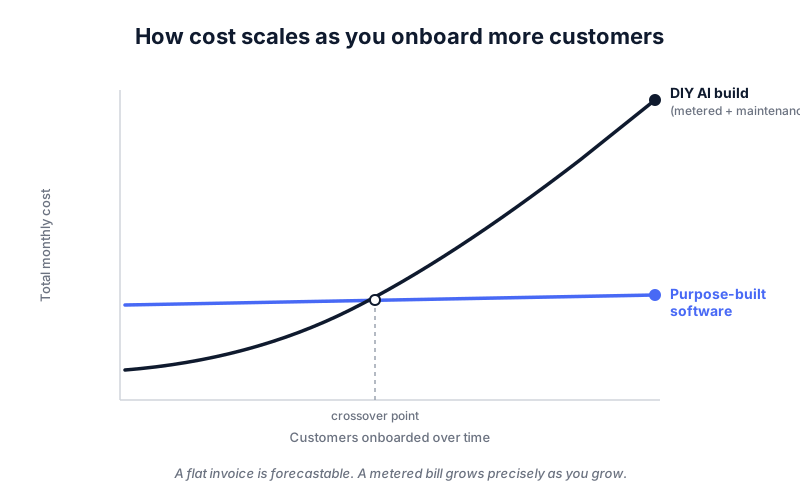
A SaaS subscription is one known, flat, forecastable number. A DIY AI build is a variable cost stack that grows with your customer base and demands continuous human attention. The single invoice you avoided reappears as several smaller, less predictable bills, plus a meaningful slice of someone's time. Here's where it actually comes from.
Inference costs scale with your success. Every onboarding interaction, every regenerated draft, every retry burns tokens. The bill rises with how many customers you onboard, how chatty each onboarding is, and which model you're calling. Unlike a flat seat price, this is a metered cost that grows precisely as you grow, and it's hard to forecast before you're already committed.
The build needs a supporting cast, and each member has a bill. The model call is one line of the system. Around it you need orchestration (your automation platform meters by task volume), somewhere to store context and state, logging, and hosting for whatever glue code exists. None of that is the headline cost, which is exactly why it gets left off the estimate.
Models change under you. The model you tuned your prompts against gets deprecated, repriced, or quietly updated. When that happens, you re-test and re-tune everything, on your timeline or the provider's. That's recurring engineering work wearing a "maintenance" label.
Trusting AI in front of customers requires watching it. To catch problems before customers do, you either buy monitoring and evaluation tooling (another bill) or you assign a human to spot-check outputs (a salary line). Most DIY builds do neither at the start. That's the reason failures stay silent until a customer surfaces them.
The largest operating cost is a person. Someone owns this thing forever: tuning prompts as they drift, handling edge cases, patching the workflow when a connected app changes its API, and answering "why did it do that" every time the output looks off. Their time is the biggest line in the real total, and it appears on exactly zero build estimates.
If you want to pressure-test this, run your own token math against your actual onboarding volume, then add the automation tier, the storage, and the hours your ops person will spend each month keeping it alive. The number rarely comes out where the weekend-project version promised.
The failure modes that cost you customers
Operating cost is what makes a build expensive. The failure modes are what make it dangerous.
The person who built it leaves. This is the most predictable risk and the most underestimated. When the workflow lives in one person's prompt library, one person's automation account, and one person's memory of why it's wired the way it is, you don't have a system. You have a single point of failure with a two-week notice period. CS teams turn over. When that person walks, you're reverse-engineering something that was never designed to be handed off.
Prompts degrade, and the failures are silent. LLM outputs aren't deterministic. A workflow that ran reliably in month one drifts by month four. A small change in how a customer phrases an intake answer can push the whole thing sideways, and the outputs still look right. Purpose-built software is designed to surface problems, with status tracking, alerting, and visibility built in. A glued-together internal build fails quietly, and you learn about it when a customer escalates. By then the relationship may already be damaged.
You're experimenting on the customers who matter most. Onboarding is the highest-stakes moment in the relationship. It sets the trajectory for retention, expansion, and referrals. An in-house AI build is, by definition, unproven, which makes it an experiment. You're running that experiment on the people who just paid you and are forming their first real opinion about whether you deliver what you sold. The tolerance for "let's see how this holds up" at that moment should be close to zero.
The narrow case where building is the right call
We would rather say this plainly than pretend the answer is always the same.
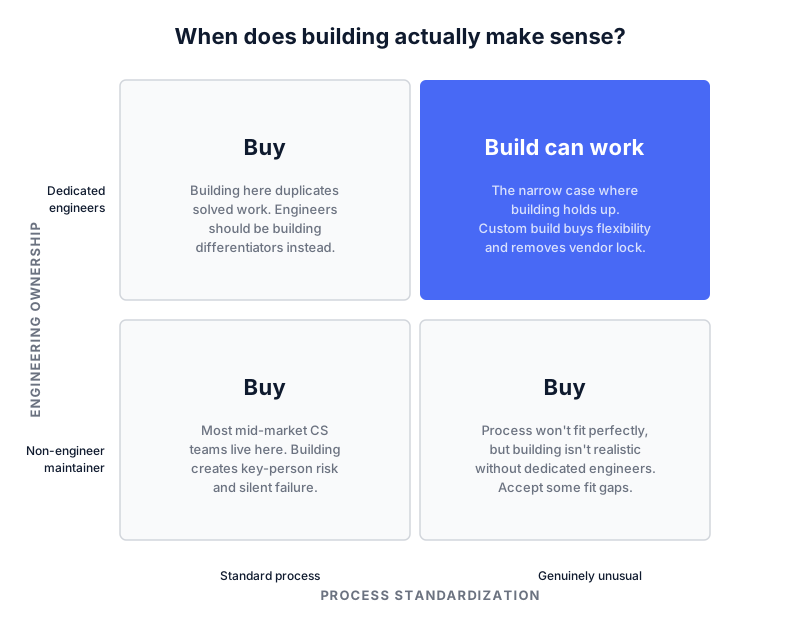
There is a real exception, and it's narrow. If your onboarding process is genuinely unusual, with edge cases and customer-specific logic no opinionated product would accommodate, and you have engineering resources to build and maintain it responsibly, then a custom build buys you flexibility and removes vendor dependency. Those are the conditions where it holds up.
Most SMB and mid-market CS teams don't meet them. A standard-ish process plus a non-engineer maintainer is the common case, and it's the case where everything above comes due.
What buying actually costs you
Glossing over the tradeoffs of purpose-built software wouldn't serve anyone, so here they are straight.
It costs more upfront than an API key, because it's a paid platform rather than a free-tier integration. Getting your team running takes real implementation effort, with a learning curve, configuration, and change management. It's opinionated by design, which is an asset for most SMB and mid-market teams and a constraint for anyone with a highly non-standard workflow. And you're in a vendor relationship, which means renewals, pricing you don't fully control, and reliance on a roadmap. Those are real costs. Anyone who tells you otherwise is selling, not advising.
The difference is that these costs are visible and forecastable. The build's costs are distributed invisibly across payroll and a metered bill, which is precisely what makes them easy to underestimate and hard to escape.
So, build or buy?
For most SMB and mid-market CS teams, buy. Not because building is impossible, but because the hidden operating costs, the key-person risk, the silent failures, and the live experiment on paying customers add up to a far higher total than the API key suggests. Purpose-built software means the best practices are already in place and you're not putting your customers inside your learning curve.
Most teams who build anyway figure this out between month three and month six. The ones who figure it out at month twelve have usually done real damage to customer relationships in the meantime.
Frequently asked questions
Is building your own AI onboarding tool cheaper than buying software? For most SMB and mid-market teams, no, once you count the full cost. The API charges look cheap, but the real total includes metered inference that grows with usage, the supporting infrastructure, model-churn rework, monitoring, and the ongoing time of whoever maintains it. That cost is real. It just shows up in payroll and a variable bill rather than on a single software invoice.
What are the operating costs of an in-house AI onboarding build? Recurring inference costs that scale with how many customers you onboard and how chatty each onboarding is, the bills for orchestration and storage and hosting around the model, re-testing every time the underlying model is deprecated or repriced, monitoring or QA to catch silent failures, and the standing time of the person who owns and patches the workflow. The last one is usually the largest and the least visible.
What are the biggest risks of building an AI onboarding workflow internally? Key-person dependency when the builder leaves, silent prompt degradation you don't catch until a customer complains, an underestimated maintenance burden on your CS ops team, and the structural risk of experimenting on paying customers during the highest-stakes moment in the relationship.
Can you use Claude Code or other LLMs to build a customer onboarding tool? Technically, yes, and faster than ever. But "can you build it" and "should you build it" are different questions. An AI-assisted build still carries every failure mode above: key-person dependency, silent degradation, operating costs that scale, and live experimentation on customers. The tools got faster. The structural risks didn't go away.
When does building in-house actually make sense? When your onboarding process is genuinely unusual enough that no opinionated product fits, and you have engineering resources to build and maintain it responsibly. That's a narrow set of conditions. Most SMB and mid-market CS teams don't meet it.
Should I evaluate Onboard.io even if I'm planning to build in house? Yes, for one reason: it's worth seeing what you'd be building before you build it. If you look closely and the build still makes sense for your situation, that's a legitimate outcome. Better to have that conversation than to spend three months building and discover the fit afterward.
Evaluating this decision right now?
We're happy to talk through whether Onboard.io is the right fit for your situation or whether a custom build makes more sense for you. No pressure in either direction. If you want to see how we'd handle your specific onboarding workflow, book a call and let's find out together.
More Posts

Top 10 Make Or Break SaaS Customer Success Metrics To Monitor

Customer Success Operations 101: The Right Way To Do CS Ops


